

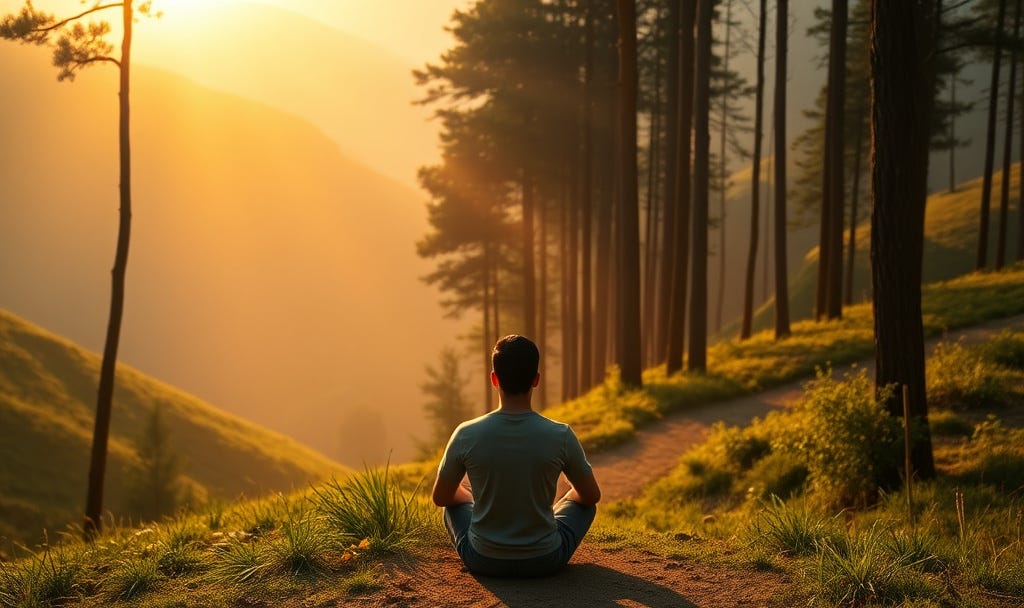
I'd wanted to bring meditation into my life for years but never made the time. Between jobs, with a real window on my hands, I went all in - and signed up for Vipassana, a ten-day silent meditation retreat built on the practice of Noble Silence: no talking, no eye contact, no gesturing. Tucked away in the hills of Northern California, I was surrounded by serious practitioners - all meditating for eleven hours a day, with nothing to distract from the practice: no phones, no books, no pen or paper. This was going to be a challenge for someone like me. I'm expressive, emotive, and enjoy being around people. Friends joked that surviving a weekend without talking would be a stretch - let alone ten full days!
The first three days were brutal, and time passed unbelievably slowly. The practice itself is called Anapana - just observing your breath at the nostrils all day, nothing more! The mind has nowhere to go but inward. There was a small walking trail at the retreat, and I'd set off thinking the loop would take twenty minutes. I'd come back, look at the clock, and it moved six. I started looking forward to the smallest, most predictable things - my daily shower because it was fixed time I could count on.
Not holding on to the past
When you sit with yourself for that long, things come up. For some people, that's heavy. I watched fellow meditators cry, weep, wail. Some got up mid-session and walked out, trying to leave the center altogether. The technique surfaces what you've buried, and for many, that's trauma - once it's out, there's no escape from it.
I felt the weight too. Plenty came up - childhood memories, old stories, moments I hadn't thought about in years. But none of it landed heavily. I wasn't carrying old grudges, unresolved regrets, or buried negative emotions - I'd let them go somewhere along the way. I sat with that for a while, even questioning whether I just hadn't gone deep enough, but I don't believe that's the case. What was giving me pause was forward-looking - career, relationships, family far away, immigration. The past wasn't pulling me down. The future, with all its uncertainty, was creating real noise in my head - and those were the sensations I needed to learn to sit with and let pass.
Equanimity, which I'd been practicing all along
The second thing that stayed with me was the principle the whole practice is built on: equanimity. Don't crave pleasant sensations. Don't push away the unpleasant ones! Just observe them and let them be. This too shall pass - applied to highs as much as lows. The first time I heard it framed that way, I had a strange moment of recognition, because I'd been practicing this for over a decade - on a tennis court.
Tennis teaches you the same thing, almost word for word. After a bad shot, the temptation to sulk, to slam the racket and to replay the mistake in your head is real. And so is the temptation to celebrate and ride the high after a winner. But you can't do either. You have to refocus, and fast, or you'll likely lose the next one. My coach drilled the same message for years: the match is long, no single point defines it, and the one who resets fastest and manages emotions best holds the advantage.
I'd internalized this through years of playing, without ever calling it equanimity. The retreat made me see that this principle wasn't new to me; I'd just been trying to apply it only inside the contained world of a tennis court, and I hadn't been extending it as deliberately to the rest of my life.
Getting to the Other Side
It took a while to get used to sitting with myself, and the key was fully giving in - to silence, to discipline, to the technique. Day five was when I got over the hump and the weight started to come off. I felt lighter, physically and mentally, in a way I hadn't in a long time. Everything around me began to feel richer - the moonlight through the sunroof at night, the trail through the trees, even vegetarian food I hadn't expected to enjoy. The clearest sign of the shift was in how I tracked time. The first few days, I'd been ticking off the days - one day done, two days down, seven more to go. By the last few, I was counting down, quietly hoping it would slow. The same person who'd struggled to imagine a weekend of silence was now thinking about asking if he could stay on.
Now, I find myself looking forward to the next long break; a chance to go back for a refresher on what I've already let slip.
A few terms used above:
• Vipassana: literally "to see things as they really are"; an ancient Indian meditation technique centered on scanning bodily sensations without reaction.
• Noble Silence: the foundational discipline of the retreat — no talking, eye contact, or gestures, for the full ten days.
• Anapana: the breath-observation practice taught in the first three days, focusing on the natural breath at the nostrils.